The heating and cooling system of a double-layer stainless steel reaction vessel is the core link ensuring the precise execution of reaction processes. Its performance directly affects material reaction efficiency, product quality, and production safety. The jacket design of the double-layer structure provides the foundation for heat exchange, enabling temperature regulation through medium circulation, with different heating and cooling methods suited for varying operational requirements. This article provides a comprehensive analysis of the principles, characteristics, and applicable scenarios of mainstream heating and cooling methods, offering reference for equipment selection and process optimization.
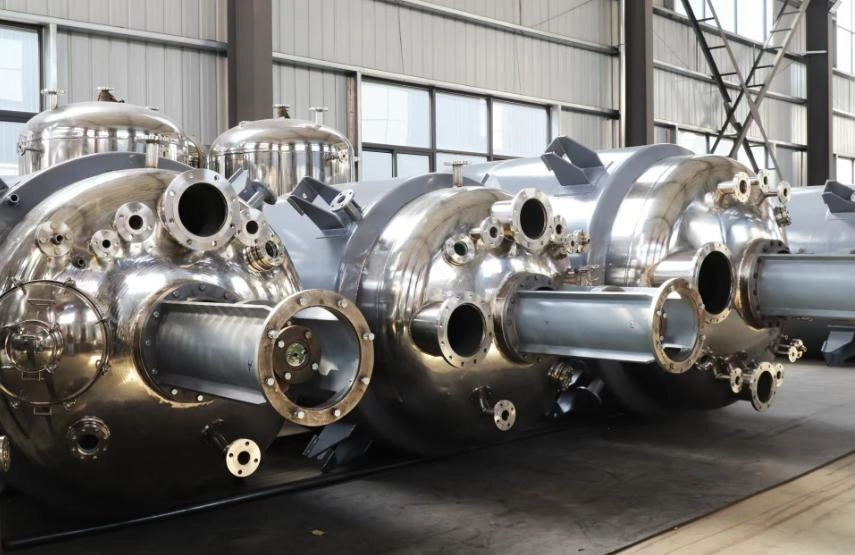
I. Mainstream Heating Methods: Core Solutions for Different Temperature Requirements
The heating methods for double-layer stainless steel reaction vessels primarily rely on jacket heat transfer. This involves introducing a heating medium into the jacket or using electric heating elements to transfer heat to the inner vessel material, thereby achieving temperature increase. Currently, mainstream heating methods are categorized into electric heating, steam heating, and thermal oil heating, each with its suitable scenarios and distinct advantages and disadvantages.
Electric heating is the most commonly used solution for small-scale applications. Its principle involves installing electric heating tubes within the jacket to generate heat directly, which then heats a thermal conductive medium (such as air or thermal oil) before transferring the heat to the inner vessel. This method offers high temperature control accuracy (achievable up to ±1°C), requires no external heat source equipment, is easy to install, and occupies minimal space. It is suitable for laboratories, small production lines, and applications with temperature requirements ≤300°C. However, electric heating has higher energy consumption, leading to relatively high operating costs in large-scale production. Additionally, heating tubes are prone to aging and require regular maintenance and replacement.
Steam heating is suitable for medium-to-high temperature and large-scale production scenarios. It uses industrial steam as the heating medium, generated by a steam boiler and introduced into the jacket. The heat released during steam condensation enables rapid temperature rise. Its advantages include uniform heating, fast heating speed, wide availability of steam sources, and relatively low cost. It is suitable for batch production in chemical and food industries with temperature requirements below 300°C. However, steam heating requires auxiliary equipment such as boilers and pipelines, resulting in higher initial investment. It also demands strict sealing performance of the equipment to prevent steam leaks that could pose safety hazards.
Thermal oil heating is designed for high-temperature applications with large temperature differentials. A heating furnace heats the thermal oil to the set temperature, and a circulation pump then directs the high-temperature thermal oil into the jacket to facilitate heat transfer. Thermal oil has a high boiling point, allowing it to reach temperatures above 300°C under normal pressure with strong temperature stability. It is suitable for fine chemical and pharmaceutical industries requiring high temperature accuracy and long reaction cycles. Its drawbacks include the need for regular thermal oil replacement and the requirement for temperature control and explosion-proof devices within the heating system, leading to higher maintenance costs.
II. Mainstream Cooling Methods: Key Guarantees for Precise Temperature Control
The cooling system complements the heating system by rapidly removing excess heat generated during the reaction process, keeping material temperatures within the process range to avoid decomposition, deterioration, or safety incidents caused by excessive heat. Mainstream cooling methods include water cooling, air cooling, and refrigerant cooling, which should be selected based on cooling requirements and site conditions.
Water cooling is the most widely applied cooling solution. Its principle involves introducing cooling water (tap water or circulating water) into the jacket, where the water flow carries away heat transferred from the inner vessel, achieving cooling. It offers high cooling efficiency and rapid temperature reduction, making it suitable for reactions with intense exothermic activity and lower temperature requirements. Its operating costs are low, and it is adaptable to production scenarios of various scales. However, water cooling heavily relies on water resources and requires a supporting cooling water circulation system (such as a cooling tower); otherwise, it can lead to significant water waste. Regular cleaning of the jacket is also necessary to prevent scale buildup from affecting heat exchange efficiency.
Air cooling is suitable for water-scarce areas or small to medium-scale production. It involves installing heat dissipation fans on the exterior of the jacket, utilizing air circulation to dissipate heat. This method requires no water resources, features simple equipment structure, and is easy to maintain. It is suitable for reactions with low exothermic activity and temperature control requirements below 100°C, such as food processing and small-scale chemical experiments. However, air cooling has lower cooling efficiency and is significantly influenced by ambient temperature. Its cooling effectiveness may decline in high-temperature environments, making it unsuitable for large-scale, highly exothermic reactions.
Refrigerant cooling is designed for low-temperature requirements. It uses cooling media such as glycol solution or liquid nitrogen, which are cooled by a refrigeration unit before being introduced into the jacket for rapid temperature reduction. This method can control temperatures below 0°C or even lower. It offers high temperature control accuracy and a wide cooling range, making it suitable for pharmaceutical and fine chemical industries with stringent low-temperature requirements, such as material crystallization or low-temperature reaction processes. However, refrigerant cooling systems entail high initial investment, significant energy consumption during operation, and require specialized refrigeration equipment with higher technical maintenance demands.
III. Key Considerations for Selecting Heating and Cooling Methods
Selection should prioritize matching process requirements, focusing first on temperature range, heating/cooling speed, and exothermic/endothermic intensity: high-temperature applications should prioritize steam or thermal oil heating, while low-temperature cooling should prioritize refrigerant cooling. Small-scale production may opt for a combination of electric heating and air cooling, whereas large-scale production is better suited for steam heating paired with water cooling. Site conditions and cost budgets must also be considered. Water cooling should be avoided in water-scarce areas, while small enterprises with limited budgets may prioritize electric heating and air cooling systems.
Heating and cooling methods for double-layer stainless steel reaction vessels each have their suitable scenarios. Selection should integrate process requirements, site resources, and cost budgets while emphasizing temperature control accuracy and safety performance of the system. Only then can efficient and stable production operations be ensured.