Industrial reactors are core equipment used in chemical, pharmaceutical, food, new material and other industries to complete processes such as material mixing, chemical reaction, dissolution and crystallization. There is a wide variety of reactor types, and proper selection directly affects production efficiency, product quality and operational safety. Understanding the main classification methods and selection principles of reactors forms the foundation of equipment specification and process design.
Classification by Structural Form
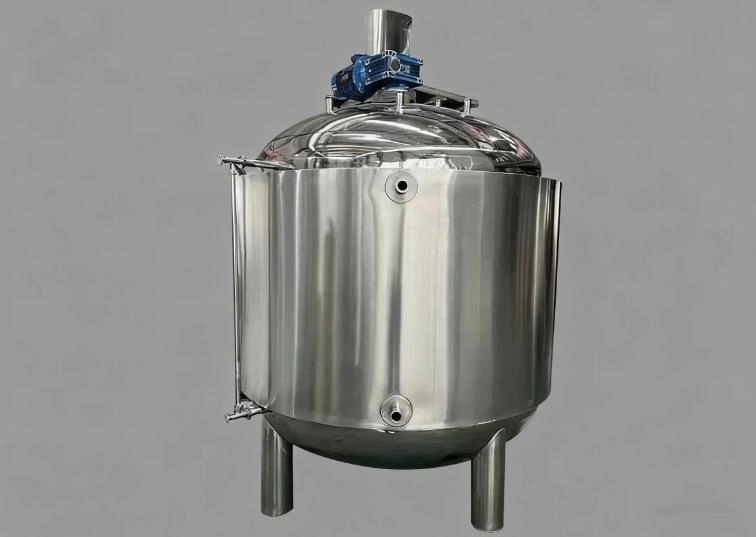
Industrial reactors are structurally divided into open-type and closed-type models.Open reactors adopt flange connection between the tank body and cover, enabling easy disassembly, cleaning and maintenance. They are suitable for multi-product production or frequent formula switching.Closed reactors feature an integrated welded tank and cover, delivering compact structure and superior tightness. They are widely used in high�temperature, high�pressure and highly toxic working conditions.
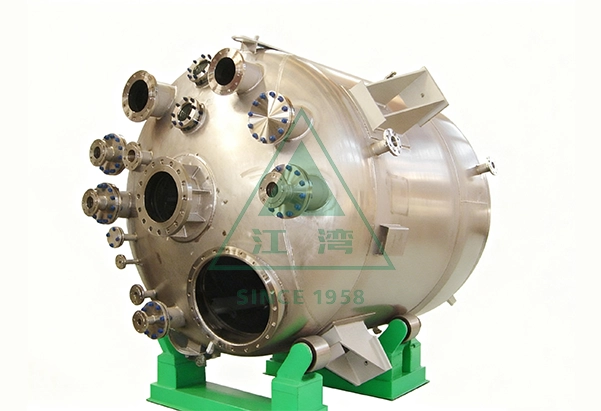
In terms of tank shape, reactors are mainly divided into vertical and horizontal types.Vertical reactors occupy less floor space and provide stable mixing performance, applicable to most conventional chemical reactions.Horizontal reactors are ideal for processes requiring a large gas�liquid contact area or long material residence time.
Classification by Heating Method
The heating mode directly determines heat transfer efficiency and temperature control accuracy.Jacketed reactors are the most common type. A jacket structure arranged on the outer tank wall allows heating or cooling by circulating steam, thermal oil or cooling water. Multiple jacket designs are available, including conventional jackets, halfcoil jackets and honeycomb jackets. With high heat transfer efficiency and pressure resistance, half�coil jackets are widely adopted in fine chemical production.
Internal coil reactors install heat exchange coils inside the tank. The medium exchanges heat directly with process materials to achieve a higher heat transfer coefficient, meeting rapid heating and cooling requirements.
Electric heating reactors use heating rods or electric heating wires, which are suitable for sites without steam supply, while explosion�proof measures must be strictly guaranteed.
External circulation heating reactors heat materials through an external heat exchanger, making them suitable for large�volume vessels and processes requiring ultra�high temperature uniformity.
Classification by Agitation Type
The agitation system is critical for uniform material mixing and stable reaction.
Paddle agitator: simple structure, suitable for mixing and dissolving low viscosity liquids.
Turbine agitator: strong shearing force, applied in dispersion, emulsification and gas-liquid mass transfer processes.
Anchor agitator: designed for high�viscosity media; the wall�scraping structure prevents material adhesion and coking.
Frame agitator: structurally reinforced based on anchor type, suitable for medium to high�viscosity materials
Screw agitator: applicable to ultra�high viscosity materials to realize stable axial circulation.
Agitator selection comprehensively considers material viscosity, density difference, solid particle content and gas dispersion demands.
Core Basis for Reactor Selection
Process parameters are the primary consideration, including operating pressure, operating temperature, material properties and reaction characteristics.Operating pressure defines the equipment pressure grade. Closed vessels equipped with safety valves and rupture discs are mandatory for high�pressure conditions.Operating temperature affects material selection. Heat�resistant stainless steel is adopted for high�temperature service, while low�temperature toughness must be guaranteed for cryogenic working conditions.
Material corrosion is another decisive factor. Glass-lined vessels or Hastelloy alloy are selected for strongly corrosive media. For materials containing solid particles, tank bottom structure and agitator form shall be optimized to avoid sedimentation.
Volume and overall dimensions are determined by batch output, filling coefficient and reaction characteristics. The effective working volume of a reactor generally accounts for 60% to 80% of the nominal volume; the filling ratio shall be further reduced for foaming or boiling reactions.
Agitator power is calculated according to medium viscosity and mixing purpose. Insufficient power leads to poor mixing, while excessive power causes unnecessary energy consumption.
Sealing configuration is also essential. Packing sealing is applicable to normal pressure and low�pressure environments; mechanical sealing is required for vacuum and high�pressure working conditions. Double�end mechanical seals with a sealing liquid system are specified for highly toxic, flammable and explosive media.