Shell-and-tube heat exchangers are the most widely used heat transfer equipment in industrial applications. The design of their tube side structure directly determines fluid flow patterns, heat transfer efficiency, pressure drop, and the convenience of cleaning and maintenance. A clear understanding of tube side construction is the foundation for equipment selection, operational management, and routine upkeep.

Basic Composition of the Tube Side
The tube side refers to the flow path where the medium passes through the interior of the tube bundle, consisting of several core components. Channel boxes are arranged at both ends of the heat exchanger to distribute and collect process fluids, with common types including flat cover channel boxes, head-type channel boxes, and detachable structures. Tube sheets secure the tube bundle and connect the shell and channel boxes. The number of drilled holes matches the quantity of heat exchange tubes, and tube ends are sealed to the tube sheet by expansion jointing or welding.
The tube bundle, composed of hundreds or thousands of heat exchange tubes, serves as the core zone for heat transfer. Common specifications include tube diameters of 19 mm or 25 mm, with wall thicknesses ranging from 1 mm to 2 mm. Partition plates installed inside the channel boxes divide the tube bundle into independent flow passages, acting as a key component for multi-pass tube side design.
Comparison Between Single-pass and Multi-pass Tube Side
In a single-pass design, fluid enters from one channel box, flows through all tubes in a single stroke, and discharges from the opposite end. This structure features simple construction and low pressure drop. However, the low flow velocity results in a relatively low heat transfer coefficient, making it suitable for working conditions with large flow rates and limited allowable pressure loss.
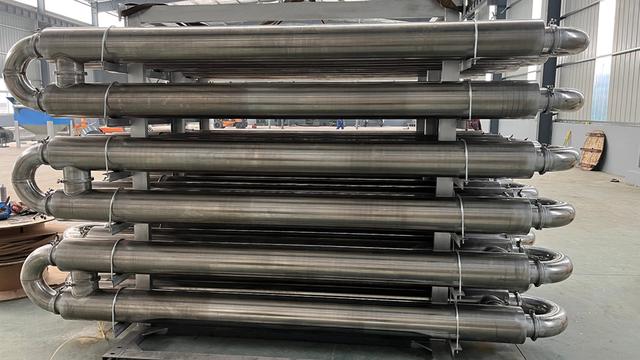
For multi-pass designs, the fluid travels back and forth inside the tube bundle, typically in two-pass, four-pass, six-pass or more configurations. Guided by partition plates, the medium flows through a section of the tube bundle first, reverses direction repeatedly, and exits after circulating through multiple groups of tubes.
The core advantage of multi-pass layout is the significant increase in flow velocity under the same total flow rate. For instance, the flow speed of a two-pass tube side doubles that of a single-pass design. Higher velocity enhances turbulence intensity, raises the convective heat transfer coefficient, and greatly improves overall thermal performance. Multi-pass structures are especially applicable to low-flow working conditions, effectively compensating for insufficient fluid velocity.
Nevertheless, multi-pass designs come with inherent drawbacks. Pressure drop increases geometrically with rising flow velocity, leading to higher energy consumption for pumps and fans. In addition, partition plates complicate manufacturing processes and introduce extra risks of fluid leakage.
Selection Principles for Tube Pass Number
The selection of tube pass quantity requires a balance between heat transfer performance and operating energy consumption, with no universal standard. Configuration must be customized according to actual process conditions.
For high-flow and low-viscosity media, a single-pass layout is generally preferred. The natural flow velocity is sufficient for efficient heat exchange, avoiding excessive pressure drop caused by unnecessary flow restriction. For low-flow and high-viscosity fluids, two-pass or four-pass designs effectively accelerate flow speed and strengthen heat transfer.
For fouling-prone media, a moderately increased flow velocity inhibits scale accumulation, and the two-pass scheme is the most common choice. In high-pressure service, single-pass construction simplifies the pressure-bearing structure of channel boxes for higher operational safety. In gas-liquid heat exchange systems, gas phases with low natural heat transfer coefficients usually adopt multi-pass tube sides to boost thermal efficiency.
Shanghai Jiangwan Chemical Equipment Co., Ltd. focuses on the research, development and production of non-standard equipment such as reaction kettles, heat exchangers, stainless steel reactors, tower vessels, modular units, freeze-dryers and cold traps. The company holds ASME U-stamp certification, EU PED certification, Korean Kosha certification and EAC certification. Its products are widely applied in chemical, petrochemical, fine chemical, pharmaceutical, food, light industry and environmental protection fields. Customized high-compatibility equipment solutions are available to meet personalized process demands. For more information, please feel free to contact our team.