Among all types of shell-and-tube heat exchangers, the fixed tube sheet type and the floating head type are the two most common structures. Though similar in appearance — both consisting of a shell, tube bundle and tube sheet — their core differences determine that one suits mild working conditions, while the other is tailored for harsh industrial scenarios.
Fundamental Difference in Thermal Compensation Capacity
In fixed tube sheet heat exchangers, the tube sheets at both ends are rigidly welded to the shell, binding the tube bundle and shell into an integral structure. When a temperature difference exists between the tube side and shell side, the two components expand at different rates. Restricted by the rigid structure, free expansion and contraction are impossible, resulting in severe internal thermal stress.
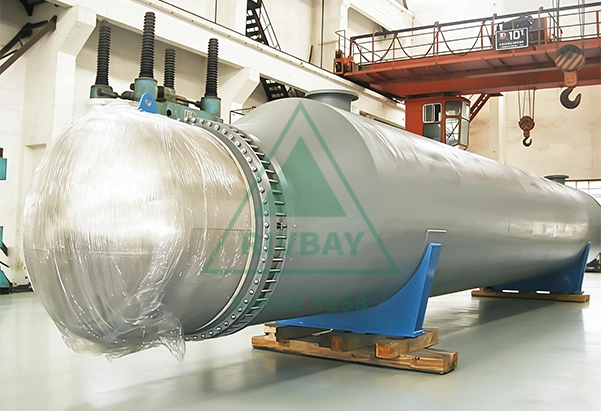
To mitigate this issue, two common design measures are adopted: first, installing expansion joints on the shell side to absorb partial axial displacement through corrugated structures; second, strictly limiting the operating temperature difference, generally within 50 ℃. Even with such measures, the fixed tube sheet design remains limited in its tolerance for temperature fluctuations.
The floating head heat exchanger adopts an entirely different design concept. One tube sheet is fixed to the shell, while the other is freely movable. When the tube bundle expands under high temperature, the floating head slides backward to avoid squeezing the shell; it resets automatically during cooling. This unrestricted structure completely eliminates thermal stress, allowing it to withstand temperature differences of 200 ℃ or above without relying on expansion joints. In terms of thermal compensation, floating head designs adapt to nearly all temperature-difference conditions.
Distinct Differences in Maintainability
The tube bundle of a fixed tube sheet heat exchanger cannot be removed. Cleaning is limited to chemical treatment or high-pressure water flushing inside the tubes, making shell-side cleaning extremely difficult. Severe shell-side fouling or tube corrosion is nearly impossible to repair, often requiring full equipment replacement. This leads to a higher life-cycle cost for long-term industrial operation.
The floating head heat exchanger completely solves this problem. The entire tube bundle can be extracted. Operators only need to detach the floating head end cover to pull out the tube bundle for mechanical cleaning, tube replacement and comprehensive maintenance. This advantage is critical for fouling-prone media such as circulating water and high-viscosity oil products. Regular bundle extraction and cleaning greatly extend equipment service life. Despite higher initial investment, it delivers better economic benefits in long-term operation.
Different Application Positioning
Fixed tube sheet heat exchangers are ideal for conditions with minor temperature differences, clean media and infrequent maintenance. In petrochemical, power and other industries, they are the preferred choice for mild process environments, thanks to their simple structure and low cost. With fewer sealing points and low leakage risks, they are also widely used in scenarios with stringent safety requirements.
Floating head heat exchangers are engineered for harsh conditions featuring large temperature differences, easy fouling and regular maintenance demands. They serve as standard equipment in refining processes such as atmospheric and vacuum distillation and catalytic cracking, as well as high-temperature and high-pressure chemical reactor systems. Although structurally complex and more costly, their outstanding reliability and serviceability are irreplaceable under severe working conditions.

Sealing Structure and Installation Requirements
Fixed tube sheet designs only require seals between the channel and tube sheet, as well as between the shell and tube sheet. With fewer sealing points, leakage risks are minimized, and installation is straightforward.
By contrast, floating head exchangers adopt detachable sealing at the floating head end between the floating head cover and tube sheet. More sealing points raise higher standards for installation quality and gasket materials. Sufficient space must be reserved for bundle extraction, usually with a clear length equal to the tube bundle length plus 500 millimeters.
The selection between fixed tube sheet and floating head heat exchangers depends essentially on rational analysis of actual working conditions. The fixed tube sheet type delivers optimal cost performance for low temperature difference, clean media and low maintenance frequency. For harsh environments with large temperature swings, heavy fouling and routine upkeep, the floating head type commands a reasonable premium due to its comprehensive performance advantages.
A clear understanding of their thermal compensation principles and maintenance characteristics enables more rational and targeted equipment selection.