In heavy industries such as petroleum refining, chemical engineering and power generation, heat exchangers frequently operate under extreme conditions with ultra-high temperatures reaching thousands of degrees Celsius. When process media are heated to such extreme levels, how can stable and safe equipment operation be guaranteed? Thanks to its unique thermal compensation capability and flexible convection design, the floating head heat exchanger has become the primary solution for high-temperature working conditions.
Division and coordination between forced circulation and natural convection
The core advantage of the floating head heat exchanger lies in its dual-channel design for the tube side and shell side, where two independent media complete heat transfer through coordinated forced circulation and natural convection.
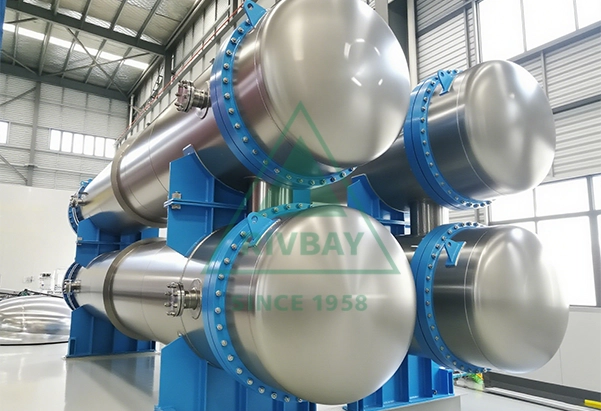
Forced circulation on the tube side means high-temperature media flow through the tube bundle at a controlled high velocity driven by circulating pumps. Its key strengths include adjustable flow speed and high heat transfer coefficients. According to process requirements, engineers can adjust pump flow rates and tube passes to extend the medium flow path inside tubes, greatly improving convective heat exchange efficiency. For high-viscosity or fouling-prone media, forced circulation continuously scours tube walls and effectively slows down scale accumulation.
Flow patterns on the shell side feature higher flexibility. Shell-side media may include steam, cooling water or process fluids. In certain designs such as circulating cooling water systems, the shell side adopts forced circulation to enhance turbulence and optimize heat transfer performance. In other high-temperature scenarios, such as waste heat recovery units, shell-side media form natural convection driven by density differences. In either mode, guided by baffles, shell-side fluid continuously changes flow direction and flushes the outer surface of the tube bundle to complete heat absorption and release.
Forced circulation and natural convection are not mutually exclusive in floating head heat exchangers. Instead, they are flexibly combined based on actual working conditions. For scenarios requiring rapid heat removal, forced circulation serves as the optimal option. For applications dominated by temperature differences and with high pumping costs, natural convection delivers superior economic benefits.
How the floating head structure relieves high-temperature thermal stress
The greatest challenge under high-temperature conditions is not excessive heat itself, but mechanical stress caused by inconsistent thermal expansion and contraction. High-temperature media inside tubes cause tube bundles to thermally elongate, while the shell operates at a lower temperature or experiences asynchronous temperature changes. Fixed tube sheet heat exchangers cannot accommodate such dimensional differences, which may eventually lead to weld cracking or tube bending deformation.
The floating head heat exchanger adopts a concise and ingenious solution: one fixed end and one free floating end. The floating head of the tube bundle is capable of axial movement inside the shell. When tubes elongate under heat, the floating head slides backward to avoid squeezing the shell; during cooling and contraction, the floating head resets automatically, maintaining a stress-free structural state at all times. This design enables floating head heat exchangers to withstand continuous operation at temperatures up to 450 ℃ or higher, and supports frequent start-stop cycles without cumulative fatigue damage.
Beyond the floating head structure, reliable performance in high-temperature environments is further ensured by optimized sealing solutions. Although the sealing structure at the floating head is more complex than that of fixed tube sheet equipment, well-designed dual-sealing systems or metal sealing rings maintain stable sealing performance under sustained high temperatures.
Selection and operation guidelines for high-temperature service
Material compatibility is the primary consideration. Heat-resistant alloys including 304H, 316H and chromium-molybdenum steel are recommended for high-temperature sides. These materials provide excellent high-temperature oxidation resistance and sufficient creep strength, preventing oxidation deterioration and creep failure during long-term operation.
Reasonable flow velocity design is equally critical. Forced-circulation sides shall maintain a controlled flow rate of 1 to 3 meters per second. This range balances efficient heat transfer with effective prevention of flow-induced erosion and corrosion. For high-temperature media, insufficient flow velocity may trigger local overheating and accelerate coking and internal corrosion.
Under extreme temperature difference conditions, even floating head structures may require auxiliary compensation through shell-side expansion joints. This dual thermal compensation design further relieves thermal stress, making it suitable for working conditions with drastic temperature fluctuations and frequent startup and shutdown. In daily operation, temperature rise and fall rates must be strictly controlled. Rapid heating leads to concentrated differential stress, while abrupt cooling causes severe thermal shock. Standardized operating procedures effectively extend the overall service life of high-temperature floating head heat exchangers.
With the structural design of one fixed end and one movable end, floating head heat exchangers realize the coordinated application of forced circulation and natural convection in high-temperature environments. The solution efficiently balances high heat transfer efficiency and reliable thermal stress relief, making it the preferred heat transfer equipment for heavy industrial production.