In chemical production, packed towers are essential equipment for gas-liquid contact and separation. As the core component of a tower, packing directly determines separation efficiency. Among various packing types, structured packing has become the mainstream choice for modern packed towers due to its ordered structure and superior performance.
Structured packing consists of elements arranged regularly in specific geometric shapes, standing in clear contrast to randomly stacked random packing. This ordered arrangement creates well-defined, unobstructed flow channels for gas and liquid inside the tower, reducing flow resistance while improving mass transfer efficiency. Much like urban traffic networks, organized road systems always operate more smoothly than chaotic narrow alleys. According to structural differences, structured packing is mainly categorized into three major types: grid packing, corrugated packing, and pulse packing.
1. Grid Packing
Grid packing features the simplest structure among all structured packing. It is assembled from parallel strip components arranged at fixed intervals, presenting an overall appearance of neat grid plates.
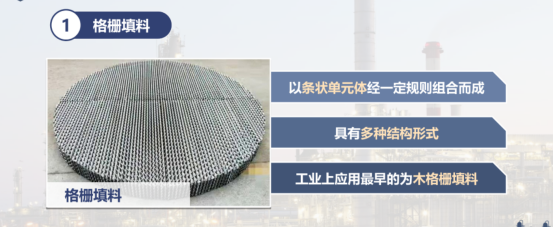
This structure delivers two remarkable characteristics: an extremely high void fraction that allows gas and liquid to pass through with minimal resistance, and wide flow channels that resist clogging effectively. Thanks to these advantages, grid packing is irreplaceable for certain demanding working conditions.
In the washing sections of vacuum towers in petroleum refining, process fluids often contain coke powder and colloidal substances that easily cause equipment blockage. The large-channel design of grid packing handles such media efficiently. It also performs excellently for high-viscosity liquids and fluids with solid particles, and its self-cleaning capability greatly reduces fouling risks. Furthermore, due to its robust mechanical strength, grid packing is commonly installed as a support layer at the bottom of towers to provide stable load-bearing support for upper packing sections.
2. Corrugated Packing
As the most widely used and well-known structured packing, corrugated packing serves as the primary solution for high-efficiency separation. It is assembled by stacking multiple thin plates pressed into corrugated profiles, with adjacent plates arranged in intersecting directions to form complex yet regular gas-liquid flow passages.
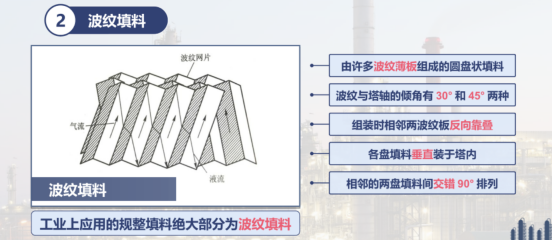
During operation, liquid flows downward and spreads into an ultra-thin liquid film over the corrugated surfaces. Rising gas travels tortuously through the intersecting channels and makes thorough contact with the liquid film.
This unique structure provides a large specific mass transfer area within limited space, delivering far higher separation efficiency than traditional packing.
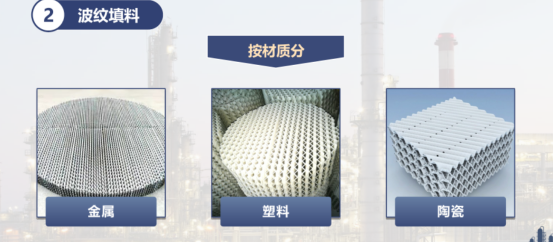
Based on material classification, corrugated packing is divided into three categories:
· Metal corrugated packing: The most common type, fabricated from thin stainless steel, copper, titanium and other metal sheets. It features high mechanical strength, thin wall thickness and low pressure drop. Especially suitable for vacuum distillation, it achieves a high theoretical stage count under minimal pressure loss.
· Plastic corrugated packing: Made of polypropylene, PTFE and other polymer materials. It offers outstanding corrosion resistance and cost-effectiveness, widely applied in acid-base environments, waste gas absorption, desulfurization and related processes.
· Ceramic corrugated packing: Renowned for high temperature resistance and strong anti-corrosion performance. It is the preferred option for highly corrosive processes such as sulfuric acid absorption towers and nitric acid concentration towers.
Corrugated packing is universally adopted across petrochemical large-scale distillation towers, fine chemical separation units, and environmental protection waste gas absorption systems. If grid packing represents rough separation processes, corrugated packing acts as a high-precision processing center, completing sophisticated separation tasks with optimal efficiency.
3. Pulse Packing
Pulse packing is a specially structured type of structured packing with a distinctive design concept different from grid and corrugated packing. It is formed by alternately stacking grid layers and packing units to create periodic converging and diverging flow passages.
When gas and liquid pass through pulse packing, they undergo periodic acceleration and deceleration, forming a cyclic pulsating flow state. Flow velocity increases in converging sections to enhance turbulence and strengthen gas-liquid mixing and contact. In diverging sections, flow slows down to facilitate phase separation and liquid redistribution. Balancing high mass transfer efficiency and moderate processing capacity, pulse packing offers a compromise solution for moderately difficult separation tasks. It delivers higher separation performance than grid packing while maintaining better anti-clogging properties than corrugated packing.
Nevertheless, compared with the extensive application of corrugated packing, pulse packing is less widely used and mainly applied in specialized industrial units and scientific research facilities.
Selection Guidelines for Structured Packing
· For media containing solid particles, polymerized or scaling components, or high-viscosity fluids: Grid packing is the most reliable option, with wide channels minimizing clogging risks.
· For clean materials requiring high separation precision and low pressure drop: Corrugated packing is the optimal choice. Material selection (metal, plastic or ceramic) depends on medium temperature and corrosiveness.
· For intermediate working conditions that require balanced efficiency and anti-fouling performance: Pulse packing serves as a practical compromise solution.
The three major categories of structured packing provide diversified separation solutions for the process industry. With continuous advancements in manufacturing technology and the development of innovative packing structures, structured packing will continue to demonstrate unique advantages in more industrial fields. We specialize in customized packing selection and supply high-quality, reliable packing products, enabling every packed tower to operate at optimal performance and create maximum economic benefits for production systems.