Tower vessels are large-scale chemical equipment composed of cylinders, heads and supports. They are widely used in chemical engineering, petroleum refining, pharmaceutical production, food processing and many other industrial sectors, serving as core equipment for processes such as distillation, absorption, desorption and extraction. Their primary function is to provide sufficient contact conditions between gas and liquid phases or between two liquid phases, so as to realize mass transfer and heat exchange. This article mainly discusses the classification and application fields of tower vessels.
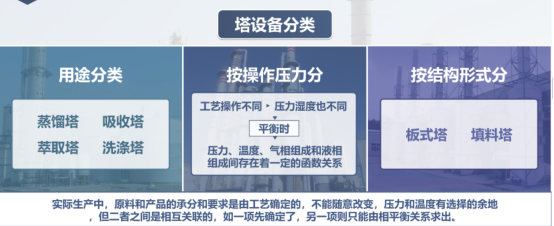
According to different internal structures, tower vessels are mainly divided into two categories: plate towers and packed towers.
1. Plate Towers
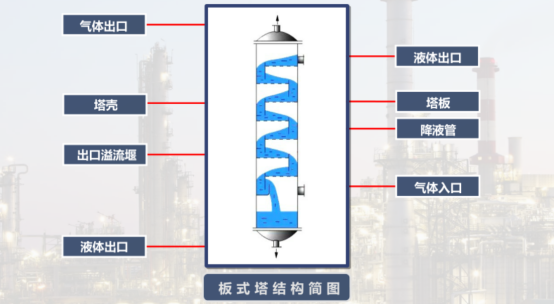
Researched and applied much earlier than packed towers, plate towers are equipped with multiple horizontal trays arranged along the tower height. Liquid flows downward by gravity, while gas rises driven by pressure difference. Gas and liquid contact and interact on each tray to complete mass transfer.
Based on different gas-liquid contact components, plate towers are further classified into various types.The most common types include bubble-cap towers, sieve plate towers and float valve towers.
· Bubble-cap towers: a classic plate tower design fitted with risers and bubble caps on trays. Featuring complex structure but excellent operational stability.
· Sieve plate towers: perforated with dense small holes on trays; gas passes directly through the holes into the liquid layer. They have a simple structure and large production capacity.
· Float valve towers: combining the advantages of the above two types. Valve holes are arranged on trays with movable floating valve covers, which automatically adjust the opening according to gas flow. They offer wide operating flexibility and high mass transfer efficiency.
Plate towers are suitable for large-capacity production with clean media, especially for complex rectification processes requiring side-stream withdrawal and intermediate heat exchange.
2. Packed Towers
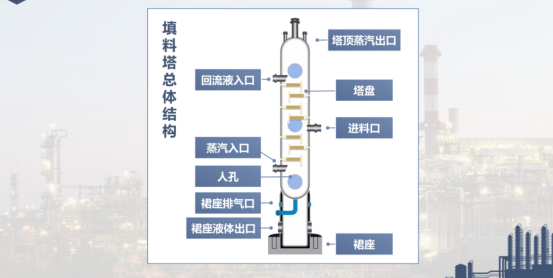
As another vital tower type, packed towers have no trays inside but are filled with packing materials at a certain height. Liquid is evenly sprayed onto the packing through a liquid distributor at the tower top and flows down in a thin film along the packing surface. Gas is fed from the tower bottom, rises through packing gaps, and contacts the liquid film in countercurrent for continuous mass transfer.
Packing is the core component of packed towers.In terms of filling forms, packing is divided into random packing (e.g., pall rings, cascade rings) and structured packing (e.g., corrugated plate packing, wire mesh corrugated packing). With regular geometric structures, structured packing delivers high separation efficiency, large throughput and low pressure drop, widely adopted in vacuum rectification for heat-sensitive materials and high-purity separation processes.
Packed towers perform excellently in handling corrosive media, foaming materials and working conditions requiring low pressure drop. Nevertheless, they are not applicable for materials containing suspended solids or prone to polymerization. In addition, excessively low liquid load will lead to incomplete wetting of the packing surface and reduced mass transfer efficiency.
3. Application Fields
As critical process equipment, tower vessels cover a wide range of fields, ranging from energy and heavy chemical industry to fine chemical engineering and environmental protection.
Petroleum Refining & Petrochemical Industry
Tower vessels are absolutely core equipment. For instance, in the refinery upgrading project of Maoming Petrochemical, four major towers including ethylene towers, propylene towers and alkali washing towers act as the central units of the ethylene plant. A single tower can reach 68 meters in length with a total weight exceeding 3,000 tons. Through rectification, these large towers separate complex raw material mixtures into high-purity basic chemical raw materials such as ethylene and propylene. Similarly, in oilfield associated gas treatment, absorption towers and regeneration towers remove acid gases (hydrogen sulfide, carbon dioxide) from natural gas to ensure safe subsequent transportation and utilization, as exemplified by the key absorption and regeneration towers in the Xushen No.9 Project of Daqing Oilfield.
Coal Chemical Industry
Tower vessels also play an indispensable role. With the clean and efficient utilization of coal becoming a mainstream trend, coal-to-liquid and coal-to-olefin projects have growing demand for large-scale tower equipment. Leading domestic coal chemical enterprises adopt ultra-long stainless steel towers over 58 meters in length for the rectification and purification of intermediate products such as methanol and dimethyl ether.
Fine Chemicals, Pharmaceuticals & Food Industry
Tower vessels are applied for the separation and purification of high-value-added products. These industries require ultra-high product purity and involve numerous heat-sensitive materials. Therefore, structured packed towers with mild operation, low pressure drop and high separation efficiency are the preferred choice. In pharmaceutical production, tower equipment is used for solvent recovery and product refining; in the food industry, it serves for alcohol purification, oil deodorization and other processes.
Environmental Protection Industry
Tower vessels are widely used in waste gas treatment and wastewater recycling. Absorption towers remove harmful pollutants such as sulfur oxides and nitrogen oxides from industrial tail gas, while desorption towers recycle volatile organic compounds from wastewater, realizing resource recovery and up-to-standard discharge.
With the coordinated development of plate towers and packed towers, as well as the continuous application of new high-efficiency internal components, tower vessels are capable of meeting increasingly stringent process requirements. They constitute an indispensable part of the modern industrial system. In the future, tower vessels will develop toward larger scale, higher efficiency and better energy conservation, providing solid support for industrial upgrading and low-carbon production.