In numerous industrial fields such as chemical engineering, petroleum refining and environmental protection, plate columns occupy a pivotal position in large-scale industrial plants thanks to their reliable and stable performance. So, what exactly is a plate column, and what unique advantages does it possess? Let us uncover the strengths of this essential industrial separation equipment.
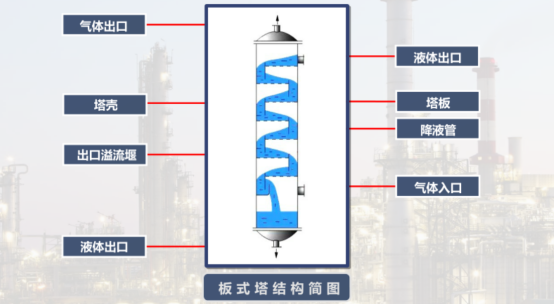
A plate column is a cylindrical vessel fitted with horizontal trays installed at regular intervals along the tower height. During operation, liquid flows downward by gravity, while gas rises upward through holes or valves on each tray. Intensive bubbling and gas-liquid contact take place on the trays to complete mass transfer and separation. Structurally, it resembles a multi�story building, where efficient material exchange between gas and liquid is realized on every floor.
Advantage 1. Strong Adaptability to Withstand Production Fluctuations
In actual industrial production, feed throughput is not constant. Tower equipment must operate stably under variable loads when upstream conditions or market demands change.The float valve tray, a typical plate column component, features adjustable valve flaps that automatically lift or sink according to gas volume. The opening height adapts dynamically to maintain reasonable gas velocity. This enables plate columns to operate efficiently within 30%–110% of the design load, easily accommodating frequent production fluctuations. In contrast, many other tower types suffer from sharp efficiency drops at low loads and operational abnormalities at high loads, with a much narrower operating range.
Advantage 2. Forced Mass Transfer, Reliable Performance under Low Liquid Loads
The overflow weir design delivers a distinctive strength: it maintains a stable liquid layer of 50–100 mm on each tray regardless of liquid flow rate. Even under extreme working conditions with minimal liquid and excessive gas, upward gas must pass through the static liquid layer to form bubbling contact, ensuring continuous and stable mass transfer.This forced contact mechanism makes plate columns irreplaceable for low-liquid absorption, partial rectification and other special processes.
Advantage 3. Easy Maintenance and High Anti-Clogging Capacity
Industrial process media often contain solid particles or scaling components. Compared with other tower types, plate columns allow convenient internal inspection and maintenance through manholes. Damaged individual trays can be cleaned or replaced in a targeted manner, just like servicing separate floors.For scaling-prone working conditions, large-hole sieve trays and other optimized structures are available. The wide gas flow channels provide a self-cleaning effect and resist blockage effectively. Once packed towers become clogged, full shutdown and complete filler removal are usually required, resulting in high maintenance costs and substantial production losses.
Advantage 4. Cost-Effective Solution for Large-Diameter Towers
Equipment cost is a key consideration for industrial projects. When processing capacity increases and tower diameter exceeds a certain threshold, plate columns demonstrate outstanding economic benefits.Engineering practice proves that for tower diameters above 800 mm, the overall cost of plate columns is 15%–25% lower than other tower types of the same specification.Large-diameter towers require complex internal components to guarantee uniform fluid distribution, and the difficulty of design and manufacturing rises nonlinearly with expanding size. However, the structural changes of plate columns are relatively gentle during scale-up, with mature and standardized manufacturing processes, ensuring superior cost performance in large-scale industrial units.
Moreover, atmospheric plate columns in refining are designed with side draw outlets at different tray heights to simultaneously produce gasoline, kerosene, diesel and multiple products. The independent layered space of trays allows engineers to install intermediate heat exchangers at designated positions, utilizing low-grade auxiliary heat or cold sources to significantly reduce overall energy consumption.

With comprehensive core strengths including wide operating flexibility, excellent low-liquid adaptability, convenient maintenance, prominent cost advantages for large diameters and flexible process compatibility, plate columns dominate in oil refining, large-scale chemical production and scaling-prone material treatment. They remain indispensable core equipment for industrial mass transfer and separation processes.