In the production lines of chemical, pharmaceutical, food and other industries, the reactor is known as the "heart" of the process flow. Raw materials are mixed and reacted inside to be finally converted into valuable products. The temperature control performance of the reactor, much like the blood-pumping efficiency of the heart, directly determines the success or failure of the entire production process. Most chemical reactions in daily production are extremely temperature-sensitive. Excessively high temperature may cause reaction runaway and produce hazardous by-products; excessively low temperature will sharply reduce the reaction rate and greatly lower production efficiency. Therefore, precise reaction temperature control is a core requirement of chemical production.
The temperature control method of traditional reactors is to weld an outer shell outside the kettle body to form an interlayer space for circulating steam or cooling water, namely the conventional jacket. Its working principle is simple: heating or cooling is realized through heat exchange between the medium inside the jacket and the materials in the kettle. However, this traditional design has an obvious defect. When heating or cooling medium flows inside the smooth jacket, it tends to form steady laminar flow, which greatly restricts heat transfer efficiency.
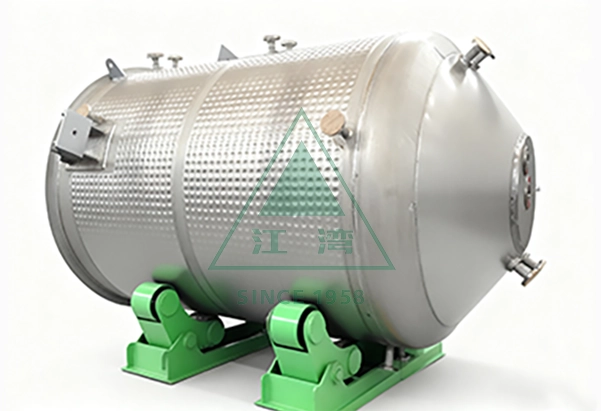
The emergence of the honeycomb jacket has completely changed this situation. Unlike traditional smooth jackets, the wall of a honeycomb jacket is covered with regularly arranged concave pits or formed by spirally wound semicircular steel pipes, creating a three-dimensional honeycomb structure. This unique design brings remarkable technical advantages:
When fluid flows through these uneven structures, continuous impact and flow direction changes break the original stable laminar state and convert it into intense turbulent flow. Turbulence greatly increases the effective heat exchange area of the fluid, boosting heat transfer efficiency by 30% to 50% or even higher. In addition, this structure significantly enhances equipment rigidity. The honeycomb structure divides the large-area jacket into numerous independent pressure-bearing units with mutual supporting effects, greatly improving the overall pressure resistance. Consequently, honeycomb jacket reactors can adopt high-pressure heating media such as high-pressure steam and support faster medium circulation speed, further strengthening the heat exchange effect.

On top of the above merits, honeycomb jackets have another often-overlooked advantage: lower medium holding capacity.
Divided by dense honeycomb structures, the internal space of the jacket holds far less heating or cooling medium than conventional designs. It delivers a much faster thermal response, making it widely applied in processes that require rapid temperature rise for reaction initiation or emergency cooling for reaction termination.
The superior performance of honeycomb jacket reactors is particularly prominent in typical application scenarios:
Polymerization ReactionIn the production of resin, rubber, adhesives and other products, the reaction system usually features high viscosity and poor heat transfer conditions, which conventional jackets struggle to handle. The high-efficiency heat exchange capacity of honeycomb jackets perfectly solves this bottleneck.

Pharmaceutical CrystallizationThe crystal form and purity of many pharmaceutical products are highly sensitive to temperature gradients and require highly uniform temperature distribution throughout the reaction space. The enhanced heat transfer performance of honeycomb jackets minimizes temperature deviation and ensures stable product quality.
Fine Chemical SynthesisFor intense exothermic reactions, rapid heat removal is critical to prevent thermal runaway and safety accidents. The outstanding heat exchange efficiency of honeycomb jackets provides solid guarantees for safe and stable production.
The upgrade from traditional smooth jackets to honeycomb jackets represents not only the evolution of equipment structure, but also a leap in industrial heat transfer technology. Drawing on bionic engineering wisdom, it solves two core pain points — low heat transfer efficiency and insufficient pressure resistance — enabling reactor temperature control to be more accurate, efficient and reliable.