With the advancement of heat exchanger manufacturing technology, plate heat exchangers have become a key driver in innovating traditional heat exchange modes. Compared with conventional tubular heat exchangers, they have reshaped energy efficiency standards across numerous industries in terms of heat transfer performance and structural design.
Nevertheless, inherent structural features and material properties also bring about certain limitations. This article systematically analyzes the core advantages and inherent disadvantages of plate heat exchangers, and explores their dual application value within the modern industrial system. The strengths of plate heat exchangers stem from their disruptive structural design. They are assembled by stacking a series of pressed corrugated thin metal plates, forming an intricate and interleaved flow channel network.
Outstanding Heat Transfer Efficiency
The corrugated plate design generates intense fluid turbulence within narrow channels, effectively breaking the laminar boundary layer with high thermal resistance. Meanwhile, the thin plates (generally only 0.4–0.8 mm thick) deliver extremely low thermal resistance. Combined with pure counter-current fluid arrangement between plates, an extremely low logarithmic mean temperature difference (LMTD) can be achieved. Under such conditions, the overall heat transfer coefficient (K value) of plate heat exchangers can reach 3 to 5 times that of shell-and-tube types. To achieve the same heat exchange capacity, a much smaller heat transfer area is required, which reduces upfront costs and overall energy consumption.
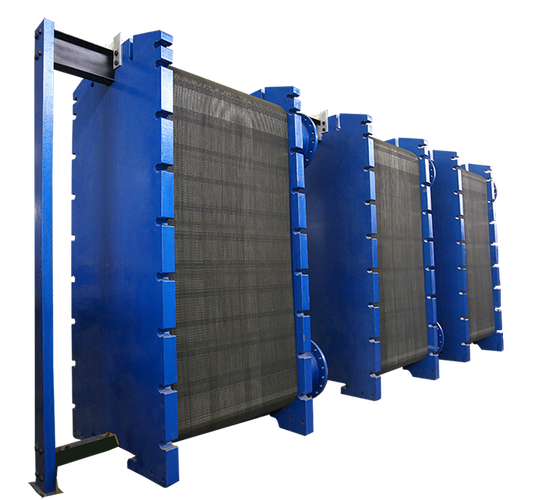
The heat transfer area per unit volume of plate heat exchangers commonly ranges from 150 to 250 ㎡/m³, while that of traditional shell-and-tube heat exchangers is usually below 100 ㎡/m³. A plate heat exchanger occupying merely one square meter of floor space can deliver equivalent heat exchange capacity to a shell-and-tube unit several times larger in size, making it highly suitable for space�constrained scenarios such as urban heating stations and renovation projects. The most prominent advantage of plate heat exchangers lies in their modular structure. The heat transfer area can be flexibly adjusted by simply adding or removing plates, enabling convenient capacity expansion to meet upgraded production demands in later project phases. Common plates are stamped from stainless steel, titanium and other high-performance materials. Compared with shell-and-tube heat exchangers that require large quantities of thick-walled pipes and heavy shells, plate types feature lower material consumption and reduced initial investment under equivalent working conditions.
Their small internal volume minimizes the retained process fluid, improving operational safety when handling expensive or hazardous media such as highly corrosive acids and alkalis. In addition, shell-and-tube equipment requires time-consuming disassembly of heavy tube bundles and complicated internal cleaning. In contrast, plate heat exchangers adopt a frame clamping structure with fully detachable modular components. In case of scaling or routine maintenance, workers can loosen the clamping bolts to inspect, clean or replace each plate individually. This greatly shortens downtime and cuts labor costs for daily upkeep, making them particularly suitable for food, pharmaceutical and other industries that demand frequent sanitary cleaning. While plate heat exchangers possess remarkable advantages, their structural design also results in obvious drawbacks. The lightweight modular construction leads to limited pressure and temperature resistance, which are mainly restricted by the structural strength of plate corrugations and the performance of sealing gaskets. Generally, brazed or fully welded plate heat exchangers can withstand higher pressure (above 4.0 MPa), while the operating pressure of conventional detachable gasket-type units is mostly limited to 1.6–2.5 MPa.
Conventional rubber gaskets such as EPDM and NBR have a maximum temperature resistance of 150–180°C, and even special fluorine rubber gaskets can hardly exceed 200°C. Consequently, they are not applicable to harsh working conditions involving high-pressure steam, high-temperature oil and gas, and other rigorous chemical processes. To maximize heat transfer efficiency, plate heat exchangers are designed with narrow inter-plate channels, typically only 3–6 mm wide. Although narrow channels enhance turbulence, they are highly vulnerable to blockage caused by solid particles, fibers, coke and polymer deposits in process fluids.
Even small solid impurities may cause channel clogging and a sharp rise in pressure drop. For this reason, they are not recommended for untreated river water, sewage, catalyst-containing media, or heavy oil prone to coking and polymerization. As the required single-unit heat load increases, a sharp rise in the number of plates will result in an overly lengthy and bulky overall structure.
This reduces structural rigidity, raises requirements for supporting frames and foundation installation, and weakens economic benefits. Moreover, heat exchanger plates are high-precision stamped parts, leading to relatively high replacement costs once damaged by corrosion or external force. The above covers a comprehensive analysis of the advantages and disadvantages of plate heat exchangers. Shanghai Rivbay Chemical Equipment Co., Ltd. specializes in the R&D and production of non-standard pressure vessels, including reaction kettles, heat exchangers, stainless steel reaction kettles, tower vessels, modular equipment, freeze dryers and cold traps. The company holds the ASME U Stamp Certificate, EU PED certification, South Korea KOSHA certification and EAC certification issued by the Eurasian Economic Union. Its products are widely applied in chemical, petrochemical, fine chemical, pharmaceutical, food, light industry, environmental protection and other sectors. Customized, highly compatible equipment solutions are available for diverse working conditions. Professional consultation is warmly welcomed.